Some people point to moments that changed their life. Stephen Michaels points to people.
Michaels has wanted to be a doctor as long as he can remember.
“As a football player, I was hurt a lot of the time. I think a lot of athletes are, so I wanted to do something with orthopedics or sports medicine,” Michaels said. “I never really thought about going into pediatrics. It just never crossed my mind.”
Michaels didn’t know it at the time, but his first step toward pediatric care was about to happen, thanks to a 16-year-old named Sam.
Beyond a teammate
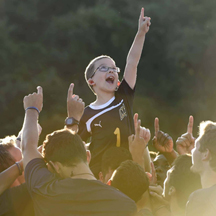
Michaels first got involved with Team IMPACT while he was on the football team at Tufts University. Team IMPACT matches children with serious illnesses and disabilities with college sports teams to foster long-lasting relationships. Matches last up to two years, and children attend games and practices, team events, and other activities. The student athletes become part of the child’s support system.
In 2021, high school junior Sam was matched with the Tufts University football team. Michaels and his teammates spent significant time with Sam, both on and off the field, and formed a deep relationship with him.
“Sam just wanted to come over, hang out, eat food with us,” Michaels said. “We were a social outlet for Sam; we got him ready to go to college. It wasn’t what I call the ‘Disney World Effect,’ a once-in-a-lifetime, starstruck kind of thing. We were all just hanging out and having fun. Sam was just one of the guys; he was a great friend.”
This experience introduced Michaels to the psychosocial model of care and the importance of patient care outside of the health care setting. It also inspired him to stay involved with Team IMPACT. Michaels became a fellow with the organization in 2023. He helps bridge the gap between the nonprofit and student athletes and ensures the children they are matched with have an experience as impactful as Sam’s.
Beyond a day
Since 2024, Team IMPACT fellows have joined Children’s Hospital Association’s Family Advocacy Day. Fellows support children and families as they visit policymakers to tell their stories and advocate for federal policies that support children’s health.
Michaels has attended Family Advocacy Day for the last three years. His experiences with the families were so powerful that he changed his career goals.
“I had so many fantastic conversations at Family Advocacy Day, especially with the parents,” Michaels said. “The first year I was there, the mom of a little girl I met really affected me. I told her I wanted to go into orthopedic surgery, and she told me to think about the impact I could have as a surgeon working with children. I had never really thought about changing someone’s life trajectory, but she helped me realize I could do that by working as a pediatric orthopedic surgeon.”
Now in his third year of medical school at the Medical College of Georgia, Michaels plans to enter a yearlong pediatric fellowship after an orthopedic residency. Family Advocacy Day inspired him to pursue this career, and it continues to inspire him every time he goes back.
“The first year I came to Family Advocacy Day was really eye-opening,” Michaels said. “I was just about to start medical school and didn’t really know what to expect. Talking to the families and hearing how their experiences at children’s hospitals change their lives is so emotional. I cry every year I’m there. It’s a breath of fresh air during medical school. It reminds me why I got into this, why I study so much, why I push through the hard days.”
Beyond a career
The pediatric workforce is facing a growing shortage. Despite 23% of the population being children under 18, just 8% of residents chose a pediatrics residency in 2025. The shortage exists in pediatric nurses, respiratory therapists, and mental health providers as well.
Michaels knows there are other aspiring doctors like him, who may not consider pediatrics because they don’t have experience with it. He’s grateful Family Advocacy Day showed him the impact he can have and encourages others to think about the difference they can make as a pediatrician.
“I’m drawn to the pediatric side of medicine because I’ll get to invest in kids at a younger age,” Michaels said. “I’ll be able to see how an intervention changes their life. Most importantly, I’ll get to help them have the life that every kid deserves.”