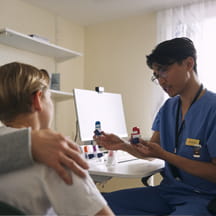
I have spent my career caring for children and families on some of their most vulnerable days. The emergency department is where fear, urgency, and uncertainty converge and fast, high-stakes decisions are critical to successful outcomes.
Over time, you recognize patterns that become impossible to ignore. These trends point to opportunities to reduce preventable crises and address social factors that quietly drive many emergency department visits.
Practicing emergency medicine does more than train you to respond quickly. It teaches you to see upstream of the event.
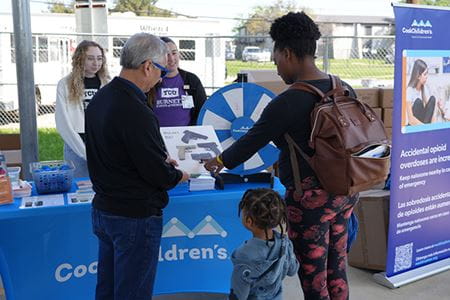
This perspective has profoundly shaped my work and strengthened my role as medical director for community health at Cook Children’s Health System. Bridging my two roles has allowed me not only to treat children in a moment of crisis but also to help build environments where fewer children reach that point at all.
The emergency department provides a real-time window into gaps in education, safety, and access across a community. It reveals not only what is happening, but to whom and where — much quicker than traditional data sources.
Many injury prevention programs do not start with abstract data alone. They are often sparked by what clinicians see in emergency departments across the country.
There is credibility in being on the front lines of care. When I speak with hospital leaders, community partners, and families, I can share real-life emergency department experiences and not just hypotheticals. I can describe what happens when prevention fails and what it costs in dollars and lives. This position bolsters alignment on and momentum for investing in upstream solutions.
Many of the conditions we treat are not random and only the tip of a much larger story.
The unintentional firearm injury of a child, the asthma exacerbation, the infant with an injury from unsafe sleep, the child that drowns in a pool — these are not isolated events. They are predictable, patterned and, in many cases, preventable.
You don’t just treat the asthma exacerbations — you see the housing conditions behind them. You don’t just manage the firearm injury — you recognize the pattern of supervision, environment, and community risk that led to it.
Cook Children’s Aim for Safety firearm injury prevention initiative was a response to an increase in the number of unintentional injuries seen in our emergency department in 2017.
Standing at the bedside of a critical patient becomes personal and sharpens your focus on interventions that are practical, reproducible, and capable of connecting with families.
I have learned that providing asthma education alone in the emergency department will not have the same impact unless that education is reinforced after the family leaves our doors. That’s where the Cook Children’s Center for Community Health is instrumental. Its Healthy Homes program aims to create healthier home environments for children through home visits, education, and support.
Effective injury prevention and community health work is never done in isolation. Building strong partnerships with community organizations, public health entities, schools, and families is vital to sustainable change beyond our hospital walls.
The medical care I provide does not fix what is rooted in complex social and environmental factors that drive many patient visits. The deeply rooted interconnection between pediatric emergency medicine and community health leadership is about shifting from reaction to prevention.
If we are successful, the impact will not be measured by what we do in the emergency department, but by what we no longer have to see.