We all know the statistics. Only about 20% of a child’s health is determined by the medical care they receive. More than half is shaped by the conditions in which they live — their family’s economic stability, access to safe and affordable housing, availability of healthy food, and the daily stresses that come with poverty.
And perhaps the most heartbreaking statistic of all: A child born in the neighborhood surrounding Dayton Children’s Hospital is projected to live 20 years less than a child born just five miles away in one of our region’s most affluent communities.
When I arrived at Dayton Children’s 14 years ago, I already understood many of the challenges facing families in our community. I had spent three decades in Montgomery County government, including 15 years as county administrator, and had witnessed the devastating loss of thousands of jobs during the financial crisis and the decline of Ohio’s manufacturing industry.
I saw firsthand how economic upheaval rippled through families — affecting housing stability, food security, and ultimately, children’s health.
Health care was a new field for me, and I had much to learn. But I also brought with me a clear understanding: Many of the obstacles our children face are rooted in long‑standing societal and economic inequities.
If Dayton Children’s was truly going to live our mission — the relentless pursuit of optimal health for every child within our reach — and fulfill our vision of reinventing the path to children’s health, we would have to think differently. We would have to step outside the traditional walls of the hospital.
Building the Center for Community Health
We began modestly, expanding on services Dayton Children’s had long provided like car seats, cribs, and essential supplies for families in need. But it quickly became clear that we needed a more coordinated, comprehensive approach.
In 2019, we opened the Center for Community Health in a new building on our main campus, now known as the Golisano Comprehensive Care Campus. This became the home for our expanded primary care clinic serving some of our most vulnerable families, as well as our newly created Family Resource Connection. Here, we began systematically screening for social needs, a practice that has since expanded across the entire hospital.
The center brought together a wide range of supports under one roof:
- A significantly expanded inventory of essential items for families
- A food pantry with ready‑to‑go boxes for those experiencing immediate food insecurity
- A demonstration kitchen where families learn to prepare healthy meals on a limited budget or for children with specialized diets
- On‑site legal services to help families navigate housing, benefits, and other barriers
- A medical home for children in foster and kinship care
- A community asthma alliance uniting agencies across the region
- Community health workers who meet families where they are — literally, in their homes and neighborhoods
Over time, the center became a catalyst for innovation, collaboration, and community‑wide change.
First-of-its-kind kinship housing
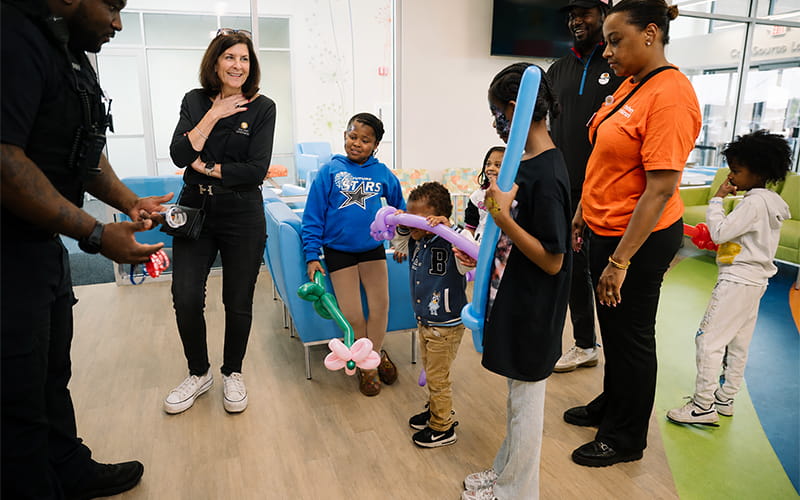
One of the most persistent challenges our families face is access to safe, affordable housing. This burden is especially heavy for kinship caregivers and families caring for children with complex medical needs. Recognizing this gap led to one of the initiatives I am most proud of: Vermillion Place.
In early 2026, we opened 26 new homes on land the hospital had acquired years earlier. These homes provide stable, supportive housing for kinship families and others facing significant barriers. Dayton Children’s contributed less than $500,000 of the $14 million total project cost. The rest came from layers of federal, state, and local funding assembled over five years.
Projects like this require perseverance, collaboration, and unwavering commitment to our mission. The reward is profound: families who finally have a safe place to call home.
Tackling infant mortality
For far too long, the Dayton region has carried a tragic statistic: an unacceptably high number of babies die before their first birthday, with Black infants disproportionately affected. Despite many efforts, the community has not made the progress our families deserve.
Because of the trust Dayton Children’s has built over decades, our Center for Community Health was asked to lead a new, community‑driven initiative, Roots to Rise. This effort is guided by mothers with lived experience and supported by new funding from the state. Together, we are working to address the root causes of infant mortality and ensure more babies are born healthy and have the opportunity to thrive.
Making a difference
I could not be prouder of how Dayton Children’s has expanded its work beyond the hospital walls. We know we cannot solve every entrenched societal challenge. But we can make a meaningful difference — one child, one family, one neighborhood at a time.
I am reminded of the story of the little boy walking along the beach, tossing a stranded starfish back into the ocean. When told he couldn’t possibly save them all, he replied, “I know. But I can save this one.”
Debbie Feldman has been CEO and president of Dayton Children’s Hospital since 2012. She will retire in June 2026.