For kinship families, housing can be hard to find.
And 4% of children in the U.S. are in kinship care.
In Ohio, that’s 100,000 kids. And in Montogomery County, Ohio, 157 children are in kinship placements.
Kinship care is when children and youth live with a family member or someone known to the family. Community health workers learned stable housing was the biggest challenge facing kinship caregivers — grandparents, aunts, uncles, and others who step in to care for children when parents cannot.
That urgent and growing need sparked Dayton Children’s Hospital to embark on a new affordable housing development designed just for them.
“This is more than housing,” said Jessica Salem, executive director of Dayton Children’s Center for Community Health. “It’s about nurturing a sense of belonging and providing support for kinship families who give so much to the children in their care.”
Foundations for better health
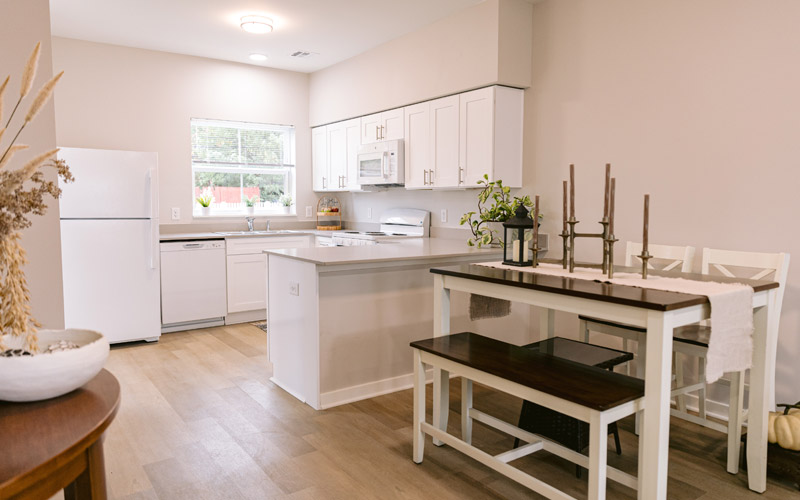
The first-of-its-kind kinship housing neighborhood, located just minutes from the hospital campus, includes 26 units, each with three bedrooms and two bathrooms to help ensure space for siblings and larger families.
Monica Walker took custody of her goddaughter, Jasmine, after the death of her parents. They were among the first to move into the new apartments.
“I’m excited. I’m overwhelmed,” Walker said in an interview. “This means everything to us.”
Many kinship families face financial strain, lack of access to services, and limited housing options.
In 2023, about 2.1 million grandparents were raising their grandchildren.
Take Patty, a 70-year-old grandmother who unexpectedly needed a home for her and her grandson. But Patty was living in a senior community where residents must be 55 or older.
Unable to move immediately, her grandson was shuffled between temporary homes. The instability took a toll that became evident in his increased anxiety, behavioral concerns, and school absences.
It’s a story Dayton Children’s staff know well. And they know relatives who care for kids when their parents can’t play an important role in keeping those children connected to their families and communities.
“We’ve approached housing in different ways, but this is a patient population we’re really interfacing a lot with,” Salem said. “The social drivers of health impact these families and the health of kids.”
Resources closer to home
The new housing does more than promote stability and health for children. In addition to apartments, the property features shared spaces like play areas and a community room.
Residents are also connected to wraparound support and have easier access to education programs, food assistance, and social services.
“This gives safe and healthy spaces for families who are often in isolation,” Salem said. “It is very integrated into the Old North Dayton neighborhood.”
The neighborhood was among those identified in the hospital’s Community Health Needs Assessment as needing better access to care.
Kinship families were part of the planning process from the beginning. The hospital’s community health and facilities teams also cultivated relationships with existing neighborhood associations and nearby schools to help prepare for the redevelopment, listen to concerns, and provide updates.
“For a catalytic project like this, you have to be intentional about who all needs to be involved and show the collaboration of the community,” Salem said. “We’re strengthening the business community, deepening relationships with residents, and improving the patient experience right at the street where they turn into the hospital.”
The hospital made sure to share stories demonstrating why the new neighborhood is important for the community and how it would impact the long-term outcomes for children.
“We didn’t know who would live there yet, but we wanted the neighborhood to accept the families,” Salem said. “We wanted the existing residents to feel like they’re part of it so they would welcome their new neighbors.”
Anchors of change
The kinship housing neighborhood is part of the hospital’s DaVinci Project, an ongoing revitalization effort focused on the Greater Old North Dayton neighborhood around Dayton Children’s.
The project launched in 2011 to develop and improve community building and has included demolition of blighted buildings, construction of a children’s garden, paint and home repair assistance for residents, wider sidewalks, new directional signs, and more.
The kinship housing was built on an old school site cleared through demolition projects. Dayton Children’s owns the property and outsources its management. All 26 units are expected to be filled by January.
As children and families move into their new homes, Dayton Children’s is there to remind people of what’s possible when health care extends beyond a hospital’s walls.
“We believe we are a community anchor and have this role to play — to be at the table for children and families is critical,” Salem said. “Community building is part of our culture, and we must all realize that the social determinants of health really impact kids.”