Six-year-old Lila Shapiro loves to dance, play with her friends, and spend time with her family. She gets the energy for all of this from an unexpected source: cornstarch.
Lila has glycogen storage disease type 1a (GSD1a), the result of a deficient G6PC gene. This deficiency prevents the liver from properly releasing glucose into the bloodstream, and people with GSD1a cannot process glycogen or create glucose from stored nutrients.
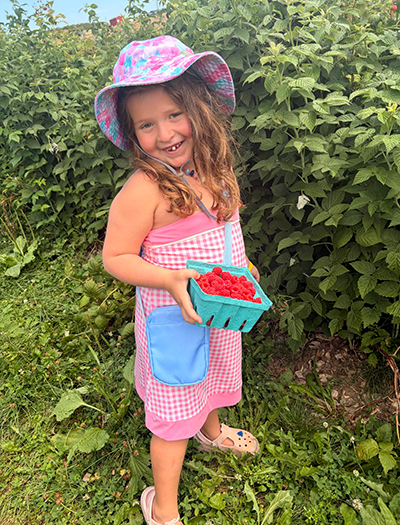
Like most people with GSD1a, Lila ingests uncooked cornstarch every three to four hours around the clock to keep her blood sugar levels stable. Missing just one dose of cornstarch leads to dangerously low blood sugar and can cause loss of consciousness, seizures, and even death.
Since Lila is only six, her parents wake up multiple times throughout the night, every night, to ensure she gets her cornstarch.
“It never stops,” said Gavy Shapiro, Lila’s mother. “We have to think through every single thing she’s going to do that day and plan her cornstarch doses around it. Any amount of activity uses up her available glucose and she needs more. She can be running on the playground and suddenly her blood sugar will drop, and she needs cornstarch immediately. She has to leave class twice a day to get it. It never ends.”
Lila lives with a glucose monitoring sensor and stomach tube to make managing the disease easier. But even with these medical devices, every aspect of her life is affected by GSD1a. Lila's diet is very limited. Between the dietary restrictions of GSD1a and the amount of cornstarch needed, people living with the disease often eat very little compared to a typical diet.
Soon, that may not be the case. In August, the FDA approved a new gene therapy, Genglycos, for GSD1a. It’s a one-time intravenous infusion to deliver a working copy of the G6PC gene. While it will not cure the disease, the gene therapy helps maintain stable blood sugar levels on less cornstarch and may increase fasting tolerance.
For patients like Lila, this is life changing. She won’t be eligible for the gene therapy until she is eight years old, but just knowing that there is treatment available gives her family hope.
“This gene therapy lets kids like Lila imagine a time they won’t have to live minute by minute,” Gavy said. “They won’t have to constantly be thinking about their next cornstarch dose and planning around it. I know it’s going to mean a better quality of life.”
The road to get here was long. GSD1a is a rare disease, affecting approximately 1 in 100,000 people. Research has been ongoing for decades in hospitals and institutions around the world. The last major breakthrough was in the 1980s and led to the use of cornstarch to manage the disease.
Connecticut Children’s is one of the leading institutions on GSD1a, in partnership with UConn Health. They participated in clinical trial work for Genglycos as one of 20 sites around the world giving infusions. As part of the study, the first infusions worldwide happened at Connecticut Children’s.
“I am very honored to be part of this,” said Rebecca Riba-Wolman, MD, director of the Glycogen Storage Disease Program and Disorders of Hypoglycemia Program at Connecticut Children’s. “The hardest parts of the disease are reducing the need for cornstarch, allowing for a more food-based diet, and expanding tolerance of fasting, and this gene therapy addresses both. This gene therapy is a tremendous leap forward.”
The Shapiro family moved from Texas to Connecticut so Lila could be treated by Riba-Wolman and her team. They knew the gene therapy research was in process and wanted Lila to get it as soon as possible.
“If Lila could get the therapy today, we would do it immediately,” Gavy said. “Our lives revolve around this disease. There is not a minute that goes by that we’re not thinking about her glucose.”
Anna Reed, another patient of Riba-Wolman, understands this well. Reed is the patient who received the first infusion worldwide in phase three of the study. She received the gene therapy at age 20 in 2022.
Although Reed still relies on cornstarch and a specialized medicine called Glycosade, she takes about 50% less than she did before receiving the gene therapy. She can go longer between doses as well.
“My quality of life is definitely better,” Reed said. “I’m usually OK for seven hours on Glycosade, so I get a full night of sleep before I need more. I have more energy, I get hungrier, and I can eat more since I’m not taking as much cornstarch.”
Riba-Wolman said long-term goals of a treatment are that it may address the comorbidities that come with GSD1a, which include kidney disease, liver disease, osteoporosis, and cancer. Studies will be ongoing to determine impact on these long-term goals.
“This is the oldest generation who has ever lived with GSD1a,” Riba-Wolman said. “We’re still learning about the long-term risks of it; these are just the risks we know about. Before cornstarch was used to manage the disease, not many people with it lived past childhood. Now they’re living into their 40s and 50s. I have hope that targeted genetic therapies could see more people living even longer. It makes people more able to less reliant on constantly getting cornstarch and makes them safer on a daily basis.”
Reed said Genglycos gave her more peace of mind about her safety.
“It’s given me some mental and emotional relief,” she said. “I still have low blood sugar at times, but it doesn’t go as low as it used to. It’s like a security blanket. I don’t have to worry about passing out or going to the hospital the way I used to. It’s not as life-threatening as it used to be.”