Lizzie and James live in a remote village in Alaska.
Their family has been deeply affected by metachromatic leukodystrophy (MLD), a rare genetic disease that affects how children grow and develop.
Babies with MLD appear healthy at birth, but around ages 1 to 2, they begin to lose the skills they once had.
“You can no longer move on your own, speak, swallow, eat,” said Laura Adang, MD, PhD, pediatric neurologist at Children’s Hospital of Philadelphia (CHOP). “Death by MLD is horrible. Slow and painful. It is also now preventable.”
A new gene therapy can slow or stop the damage caused by MLD, but only if the treatment is given before symptoms begin.
Loss of two children leads to early diagnosis
Three of Lizzie and James’s children were born with MLD. Their son, Chiefjoe, and daughter, Emily, both developed symptoms after infancy. Chiefjoe died from the disease in 2021.
“Chiefjoe and Emily, they used to talk, crawl, eat fine,” Lizzie said. “And then everything just went down.”
By the time their youngest child, Nicholas, was born, local providers — including the Indigenous Health Service team supporting the family — made sure he was tested for MLD at birth. The test confirmed the diagnosis before symptoms began, opening a critical window for treatment.
Providers in Alaska connected Nicholas’ parents with experts at the Leukodystrophy Center and the Cellular Therapy and Transplant Team at CHOP.
“It was because of the incredible local team that they fought to get testing of Nicholas at birth and referred him to us immediately,” Adang said. “Meeting Nicholas when he was so little means that we have the best possible chance of giving him a future.”
A journey from Alaska to Philadelphia
The family took four flights for a chance at lifesaving care in Philadelphia.
After a thorough evaluation, CHOP doctors recommended Nicholas for a gene therapy they hoped would prevent severe neurological decline caused by MLD.
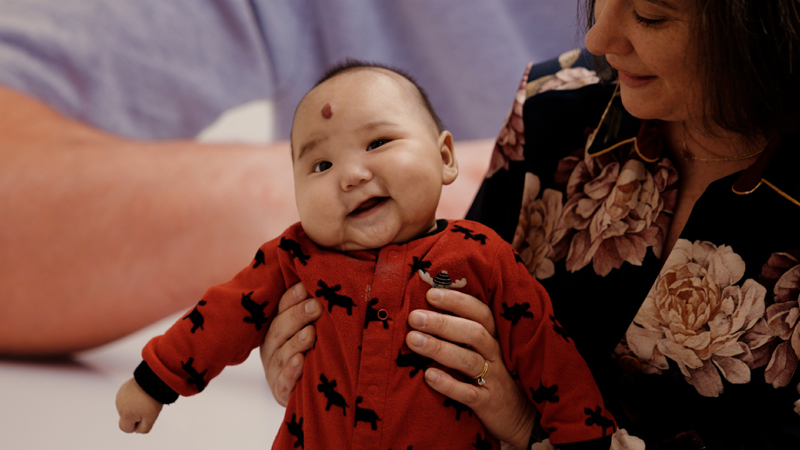
At the Leukodystrophy Center, a team of multidisciplinary doctors, clinicians, and researchers work together to provide comprehensive diagnostic testing and the most advanced treatments available to infants, children, and adults. The team is also deeply involved in research to better understand leukodystrophies and develop new therapies.
The gene therapy process
The ex vivo gene therapy recommended for Nicholas, called Lenmeldy™, is designed to replace the missing or faulty gene that causes MLD.
The treatment happens in several steps. First, experts in CHOP’s Apheresis Program collect bone marrow stem cells. The cells are then sent to a laboratory where a healthy copy of the missing gene is inserted into the stem cells.
Next, the child receives chemotherapy. This step makes room in the bone marrow so the corrected cells can grow and produce the enzyme the body needs.
Finally, the patient receives the gene-modified stem cells via an IV infusion. From there, the stem cells travel to the bone marrow and begin to produce blood cells with enough enzyme to stop progression of MLD.
At the time of his treatment in 2025, Nicholas was just over 6 months old, making him the youngest patient to receive stem cell gene therapy at CHOP.
As Nicholas began the transplant phase of treatment in Pennsylvania, the family experienced another devastating loss: Emily passed away.
The push for newborn screening
The gene therapy for MLD only works when given before symptoms appear. Historically, babies in the United States were not screened for MLD at birth.
In December 2025, that changed when the U.S. Department of Health and Human Services added MLD to the list of diseases to be included in newborn screening panels. The decision on when to add MLD to newborn screening falls on each state.
CHOP experts played a key role in advancing and standardizing the screening nationwide, so more children can be identified early, when life-saving treatment is possible.
Hope for Nicholas’s future
Two months after receiving gene therapy, Nicholas and his family were able to fly home.
He’s not showing any symptoms of the disease and will continue to be monitored as he grows. The CHOP medical team is hopeful Nicholas received treatment early enough to change the course of his disease.
For babies across the country, early MLD screening and gene therapy offer a possibility that did not exist until very recently: the chance for a future.
The original version of this article was published by Children’s Hospital of Philadelphia.