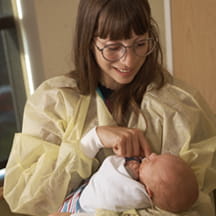
A neonatology team at Manning Family Children’s Hospital cut nighttime clinical disruptions for babies with bronchopulmonary dysplasia (BPD) by more than 50% to protect sleep critical for brain growth.
As a regional referral center caring for medically complex infants, the New Orleans hospital’s NICU sees a high proportion of babies with chronic lung disease who stay longer and are at increased risk for neurodevelopmental delays.
When the team conducted a needs assessment focused on neurodevelopment, sleep disruption emerged as a key issue. Chart reviews showed frequent overnight interruptions by staff often clustered in the hours older babies were most likely to sleep.
The team launched a quality improvement initiative that resulted in a six-hour protected sleep window for clinically stable NICU infants with BPD.
“We didn’t add anything new,” said Julie Gallois, MD, director of quality for neonatology, who led the effort. “It’s such a simple intervention, but it’s a really big impact.”
Measure and move
From the beginning, the project was intentionally interdisciplinary. Nurses, physicians, respiratory therapists, therapists, radiologists, lab techs, patient safety staff, and administrators were involved — along with family partners, including a parent whose child had recently been discharged with BPD.
“That changed the conversation,” Gallois said. “Families helped us think differently about timing, about what really mattered overnight.”
The team reviewed charts to quantify every intervention occurring during a defined overnight period and mapped them in a process chart. Then they sorted those activities into two groups: required for safety or potentially movable.
Avoidable interventions like temperature checks for stable infants, routine labs, baths, and non-urgent imaging were shifted outside the protected sleep window.
“This was only for those who were stable and appropriate,” Gallois said. “If a baby needed care, they got care.”
An EHR order set, visual flags, and structured rounding discussions helped teams identify eligible babies and communicate expectations without relying on memory alone.
Staff were trained in the protocol, and the team made it part of the department’s daily culture and practice.
“We kept sharing the idea until everyone bought into it,” Gallois said.
Results that held
The primary outcome measure — number of nighttime interventions per patient — fell by more than 50% within a week of implementation and has remained low for more than a year. The extended sleep window showed no increase in diaper dermatitis or other unintended harms.
Families noticed the difference right away.
“They told us their babies seemed more rested the next day,” Gallois said. “I didn’t expect to hear that so early.”
Long-term neurodevelopmental outcomes will take time to measure, but physical and occupational therapy teams are already working on a novel short-term participation scale. Early signs suggest babies who sleep more overnight are better able to engage meaningfully in therapy sessions.
The protocol has already sparked interest from other units, including the cardiac ICU, and from hospitals across the system and beyond.
Lessons for replication
Several factors made the project successful:
- Start with data. Chart reviews identified the biggest sources of disruption.
- Engage night staff early. Bedside nurses, especially on night shift, were essential partners.
- Involve families. Their perspectives shaped both design and buy-in.
- Build into existing systems. Embedding the protocol in rounds, order sets, and flags made it sustainable.
- Stay flexible. Eligibility criteria and timing evolved as the team learned.
Perhaps the most transferable lesson, Gallois said, is philosophical.
“In health care, improvement often means doing more,” she said. “This was about doing less, thoughtfully. And that can be just as powerful.”